Industrial Blenders
Ribbon, paddle, and plough-share blenders for homogeneous mixing of powders, granules, and paste materials. Batch and continuous configurations for 0.5–50 TPH throughput.
Industrial Blenders
Batch and continuous mixing equipment for powders, granules, and paste-consistency materials. Uniform blending achieved through mechanical agitation inside a horizontal trough or shell — mixing times typically 3–15 minutes per batch.
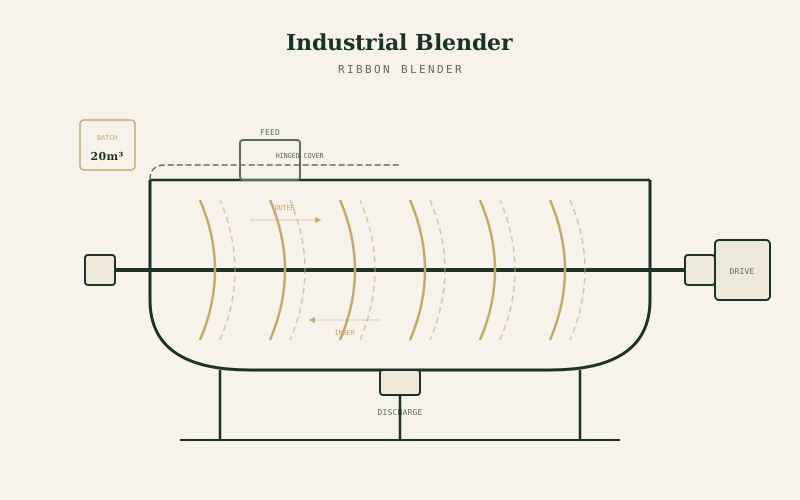
Ribbon Blender — Horizontal U-trough with inner and outer helical ribbons rotating on a central shaft. Outer ribbon moves material inward, inner ribbon moves it outward — creates cross-flow mixing pattern. Most versatile design for general dry powder blending.
Paddle Blender — Multiple flat or angled paddles on a central shaft provide gentle tumbling action. Lower shear than ribbon type — preferred for fragile materials, granules, or products where particle size integrity must be maintained.
Plough-Share Blender — Plough-shaped mixing elements mounted on a central shaft inside a cylindrical drum. High-intensity mixing with optional chopper blades for breaking lumps. Fastest mixing time — suited for cohesive powders that resist conventional blending.
Trough & Shell Design
Ribbon and paddle blenders use U-shaped troughs with close-tolerance clearance between ribbon tips and trough wall. Tighter clearance means less dead zone and better mixing — but requires precise fabrication.
Trough construction options:
- Mild steel with food-grade epoxy lining for non-corrosive chemicals
- SS 304 for food, pharmaceutical, and mildly corrosive applications
- SS 316 for aggressive chemicals and chloride environments
- Polished interior (Ra < 0.8 μm) for pharmaceutical-grade cleanability
Drive & Sealing
Shaft-mounted gearbox drives with VFD for speed control. Shaft seals prevent material leakage and contamination ingress — packed gland seals for dry powders, mechanical seals for wet or pressurized applications.
Bearing housings are outboard-mounted to keep lubricant away from the product zone. This is critical for food and pharmaceutical applications.
Discharge & Integration
Bottom discharge options:
- Butterfly valve — fast opening, good for free-flowing powders
- Slide gate — positive shut-off, handles heavy materials
- Bomb-bay doors — full-width opening for rapid batch discharge
Blenders integrate with upstream weigh hoppers for batch dosing and downstream conveyors or packaging lines for continuous operation.
Commissioning
- Trough alignment and shaft runout verification
- Seal installation and leak test
- No-load rotation check for ribbon/paddle clearance
- Test batch with representative material to verify mixing uniformity
- Sampling protocol establishment for quality control