Storage Tanks
Custom-fabricated vertical and horizontal storage tanks in mild steel or stainless steel. ASME and API compliant designs with optional agitation, heating, and instrumentation.
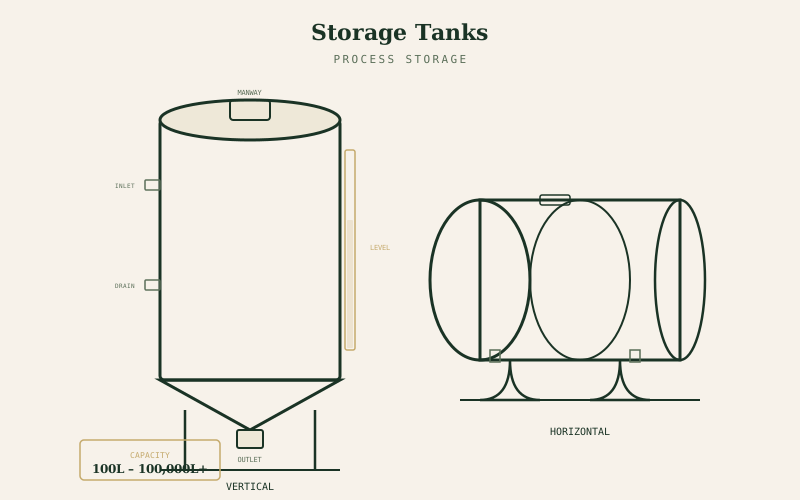
Storage Tanks
Atmospheric and pressure storage vessels for chemicals, water, fuels, and process intermediates. Every tank is custom-designed for the stored medium — material selection, wall thickness, and internals are driven by the specific application.
Vertical Tanks — Cone or flat bottom on concrete ring foundation. Higher capacity per unit footprint — standard for large-volume storage. Cone bottoms for complete drainage of viscous or settled materials.
Horizontal Tanks — Saddle-supported on steel or concrete cradles. Lower profile for height-restricted installations. Convenient for mobile or skid-mounted applications and where bottom access is needed.
Material Selection
Material choice is driven by the stored medium:
- Mild steel with epoxy lining for water, fuel oil, and non-corrosive chemicals
- SS 304 for food-grade, pharmaceutical, and mildly corrosive service
- SS 316 for chloride-containing chemicals, seawater, and aggressive media
- Rubber or FRP lining for acid storage in mild steel shells
Wall thickness calculated per ASME or API code for the design pressure, temperature, and corrosion allowance.
Internals & Accessories
- Agitator mounts — reinforced nozzles with bearing pads for top-entry mixers
- Heating jackets — half-pipe or dimple jacket for maintaining product temperature
- Baffles — vertical plates to improve mixing efficiency and prevent vortex formation
- Level instrumentation — sight glass, float gauge, or ultrasonic level transmitter
- Manways — 500mm or 600mm diameter for internal inspection access
Fabrication & Testing
Tanks are fabricated in-shop where possible and transported as complete units. Larger tanks are site-fabricated from rolled plate with field welding.
All tanks undergo:
- Radiographic examination of critical welds (per code requirements)
- Hydrostatic pressure test at 1.5x design pressure
- Leak test on all nozzle connections
- Surface preparation and coating before dispatch
Foundation Design
Foundation recommendations provided with each tank — ring wall for vertical tanks, saddle piers for horizontal. Proper foundation prevents shell distortion that causes premature failure and leak paths.